

It’s the 7 a.m. morning rush at a busy quick-service restaurant. The drive-thru speaker barks nonstop, baristas juggle cold brew lattes and iced teas, and staff stack trays of filled cups to keep up with the flow. In this chaos, no one glances twice at the disposable cup trays holding the drinks—until they do.
A barista reaches for a pre-stacked tray, only to have two cups stick together; another tray warps slightly under the weight of a full load of hot lattes; and by mid-morning, a stack of trays in the storage bin has compressed into an unmanageable pile. These small, frustrating moments aren’t just nuisances—they’re the result of choosing the wrong tray material.
At first glance, disposable cup trays might look like interchangeable commodities. Most buyers assume that as long as a tray can hold cups, material differences don’t matter much. But in high-pressure QSR environments, cafés, and delivery systems, where trays are handled, stacked, transported, and separated under constant time pressure, even tiny material and design variations rewrite the rules of operational efficiency. They directly impact how fast service moves, how often spills happen, how much labor staff expend, and the true logistics cost across the entire supply chain.
Are All Cup Trays the Same?
Cup trays are far from identical goods.
Recycled paper pulp trays are widely used because they are inexpensive and easy to produce. However, they are limited by the nature of short recycled fibers, which results in lower structural strength and inconsistent performance under stress.
Bamboo fiber cup trays, on the other hand, are engineered using longer natural fibers that create stronger interlocking structures. This gives them higher rigidity, improved moisture resistance, and more consistent behavior in real operational environments.
The practical consequence is straightforward: while both trays serve the same basic purpose, their performance diverges significantly under real-world conditions such as stacking, delivery, and high-volume service.
Key Differences Between Paper Pulp and Bamboo Fiber Trays
The differences between the two materials begin at the fiber level, with cascading effects on structural strength, durability, and real-world performance.
1. Material Composition & Structural Integrity
Paper pulp trays are made from recycled wood fibers that are relatively short and broken down during the recycling process. Because of this, the bonding between fibers is weaker, which limits the tray’s overall strength and durability.
Our bamboo fiber trays use long natural fibers extracted from bamboo, which naturally interlock more effectively during molding. This results in a denser internal structure and significantly improved rigidity.
In practical terms, this means bamboo trays are better at maintaining shape under pressure, especially when multiple filled cups are stacked or transported. Paper trays, in contrast, are more likely to deform or lose structural integrity when exposed to similar conditions.
2. Visual Comparison: Capacity & Form Factor
The first tangible difference between the two tray types is visible in their physical dimensions and stacking capacity, as illustrated below:
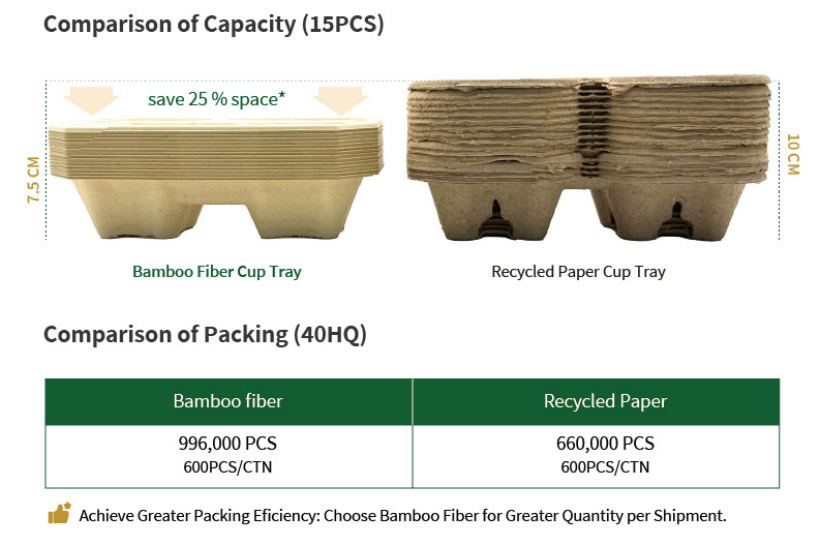
As shown , Bamboolutions’ bamboo fiber cup trays boast a 25% space-saving design compared to recycled paper alternatives. For a 15-piece tray set, bamboo fiber trays stack to just 7.5cm tall, while recycled paper trays reach 10cm. This compact form factor is the foundation of logistics efficiency—one of the most critical advantages of bamboo fiber trays.
3. Storage and Logistics Efficiency
One of the most overlooked aspects of cup tray performance is logistics efficiency. While unit price is often the focus, the real cost of a tray is determined by how efficiently it moves through storage, transportation, and distribution.
4. Packing Density and Nesting Efficiency
Bamboolutions’ bamboo fiber trays’ consistent geometry allows them to nest tightly and uniformly when stacked, drastically improving packing density in cartons and shipping containers. The data shown below translates to massive savings at scale:
| Metric | Bamboo Fiber | Recycled Paper |
|---|---|---|
| 40HQ Container Capacity | 996,000 PCS | 660,000 PCS |
| Carton Count | 600 PCS/CTN | 600 PCS/CTN |
Choosing bamboo fiber enables 50% more trays per shipment—directly cutting ocean freight costs, reducing warehouse space utilization, and lowering the total number of shipments required.
Recycled paper trays, by contrast, have slight shape variations from fiber molding inconsistencies, leading to loose stacking and wasted storage/transport space. Over high-volume orders, this inefficiency accumulates into significant financial losses.
5. Material Quality & Safety: A Direct Side-by-Side
The contrast in material quality and safety credentials is starkly evident in the breakdown below:
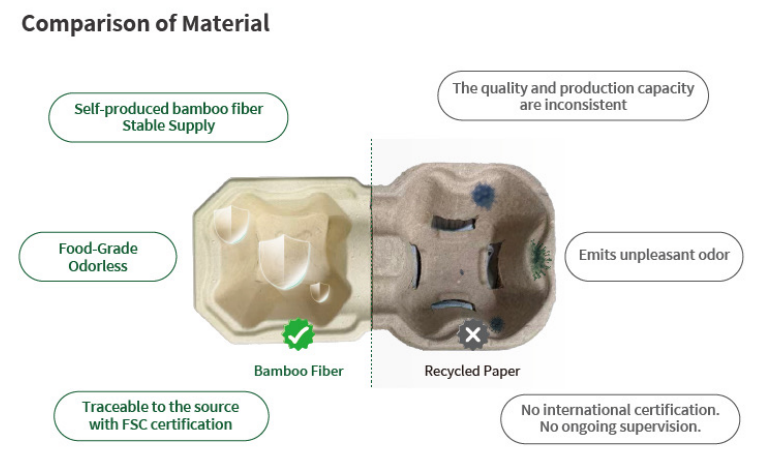
- Bamboo fiber offers self-produced, stable supply chains, food-grade odorless quality, and FSC traceability—ensuring consistency and compliance across global markets.
- Recycled paper suffers from inconsistent quality/capacity, emits unpleasant odors, and lacks international certifications or ongoing supervision, introducing operational and compliance risks.
6. Freight and Distribution Impact
When scaled across large volumes, even small differences in packing efficiency significantly affect logistics cost. A product that allows more units per container reduces ocean freight cost per unit and improves overall supply chain efficiency.
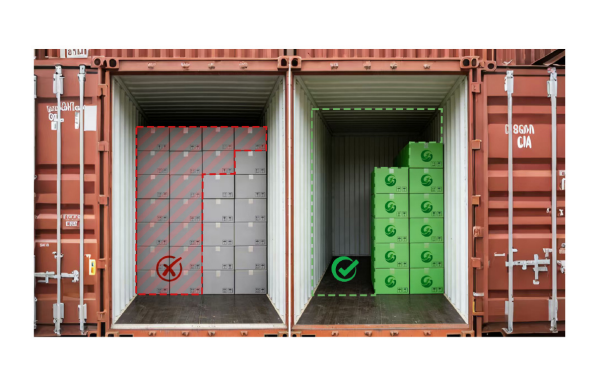
This is why logistics teams often prioritize structural consistency—not just material cost—when evaluating packaging suppliers. Bamboo fiber trays eliminate the guesswork from logistics planning, with predictable stacking and storage capabilities that streamline distribution networks.
Operational Efficiency at the Point of Use
Beyond logistics, the most immediate impact of tray design is seen during day-to-day operations in service environments.
The Hidden Bottleneck: Tray Separation
In high-volume environments, trays are pre-stacked for fast access—but paper pulp trays often create friction here.
Walk into any QSR during peak hours and you’ll see the problem: staff fumbling to separate stacked trays, their fingers slipping as paper trays stick together. A single extra second to separate one tray might seem trivial, but multiply that by 50 orders an hour, and it’s 50 lost seconds of service time—seconds that add up to slower drive-thru throughput, longer customer wait times, and frayed staff nerves.
This sticky issue stems from paper pulp’s inherent flaws: its softer surface and high moisture absorption make it compress under stacking pressure, locking layers together. Even the most experienced baristas can’t avoid the delay.
Bamboo Fiber’s Separation Advantage
Bamboo fiber trays flip this script. Thanks to wet-pressed manufacturing technology, they have a smoother surface and far more rigid structure, minimizing friction between stacked trays.
A barista can separate a bamboo fiber tray with one hand, in a single smooth motion—no fumbling, no stuck cups, no delays. During the morning rush at a busy café, this small advantage translates to faster order fulfillment, happier customers, and less physical strain on staff who spend hours handling trays all day.
In operational terms, this isn’t just a convenience—it’s a direct boost to throughput efficiency.
Load-Bearing & Moisture Resistance
The structural performance of a cup tray determines how reliably it performs under load. Paper pulp trays’ short fibers create weak bonding points; under uneven weight (e.g., multiple full cups of hot coffee and iced tea side by side), they bend or deform, risking spills and messy customer interactions.
Bamboo fiber trays, by contrast, use long interlocking fibers to form a robust internal matrix. This structure distributes weight evenly across the tray, so even fully loaded stacks stay stable during transport from the bar to the drive-thru window.
Moisture resistance is equally critical. Paper pulp trays absorb condensation from cold drinks quickly, softening and warping over time—especially in humid delivery bags or refrigerated storage. Bamboo fiber slows water penetration, maintaining its rigidity in even the most humid conditions, making it ideal
What Happens When the Wrong Tray Is Used?
When trays are selected purely on upfront cost, operational issues emerge in the supply chain—and they add up fast.
Lower-performance paper pulp trays lead to:
- Frequent stuck trays, slowing service down to a crawl during peak hours.
- Trays that soften or warp under load, increasing spill risks and product waste.
- Compressed storage stacks that require extra labor to restock and sort.
These issues don’t just frustrate staff—they hurt the customer experience. A spilled drink, a long wait for an order, or a tray that collapses in the customer’s hand is a moment that drives them to choose a competitor next time.
While each issue might seem minor on its own, their combined effect erodes operational efficiency, damages brand reputation, and costs far more than the initial per-unit savings of paper pulp trays.
Sustainability Considerations
Sustainability is a key differentiator for modern brands, but it must align with real-world performance.
- Recycled paper relies on wood-based resources; recycling cycles are limited by contamination and fiber degradation, harming long-term consistency and creating a cycle of inconsistent supply.
- Bamboo fiber is a fast-growing renewable material that regenerates quickly without replanting. It absorbs 30% more CO₂ than trees during growth, making it a far more eco-friendly choice. When processed into fiber products, it’s also compostable in 60–90 days under industrial conditions—no lingering waste in landfills.
For brands that want to prioritize sustainability and operational reliability, bamboo fiber is the clear, scalable choice.
Cost vs Total Operational Value
At first glance, paper trays are less expensive per unit—but this is only part of the equation.
Lower-cost paper trays hide hidden inefficiencies that add up over time:
- Extra labor hours spent separating stuck trays and restocking warped trays.
- Higher logistics costs from fewer trays per shipping container, requiring more frequent deliveries.
- Increased product waste from spilled drinks and collapsed trays.
Bamboo fiber trays carry a slightly higher unit price, but they eliminate these hidden costs. They reduce failure rates, cut logistics spending, speed up service, and minimize staff strain. When calculated across the entire supply chain—from warehouse storage to counter service—bamboo fiber trays deliver lower total cost of ownership and higher operational value.
When Bamboo Fiber Trays Make the Most Sense
Bamboo fiber trays excel in environments where speed, volume, and consistency are non-negotiable:
- High-traffic coffee chains, QSRs, and delivery-focused food businesses, where every second counts.
- Distributors optimizing freight efficiency and warehouse space utilization, looking to cut logistics costs at every step.
- Brands aiming to align their packaging choices with sustainability goals, without sacrificing operational performance.
Conclusion
In the chaos of a QSR morning rush, a cup tray isn’t just a disposable packaging item—it’s an active, invisible workhorse that keeps service flowing smoothly.
The difference between bamboo fiber and paper pulp trays extends far beyond material composition. It impacts how fast customers get their drinks, how stable loaded trays are during transport, how much labor staff expend, and how efficiently your supply chain runs. From warehouse storage to the drive-thru window, bamboo fiber trays offer a more consistent, reliable, and scalable solution for modern foodservice operations.
When you choose bamboo fiber, you’re not just buying a tray—you’re buying peace of mind during the busiest hours, fewer operational headaches, and a product that grows with your business.